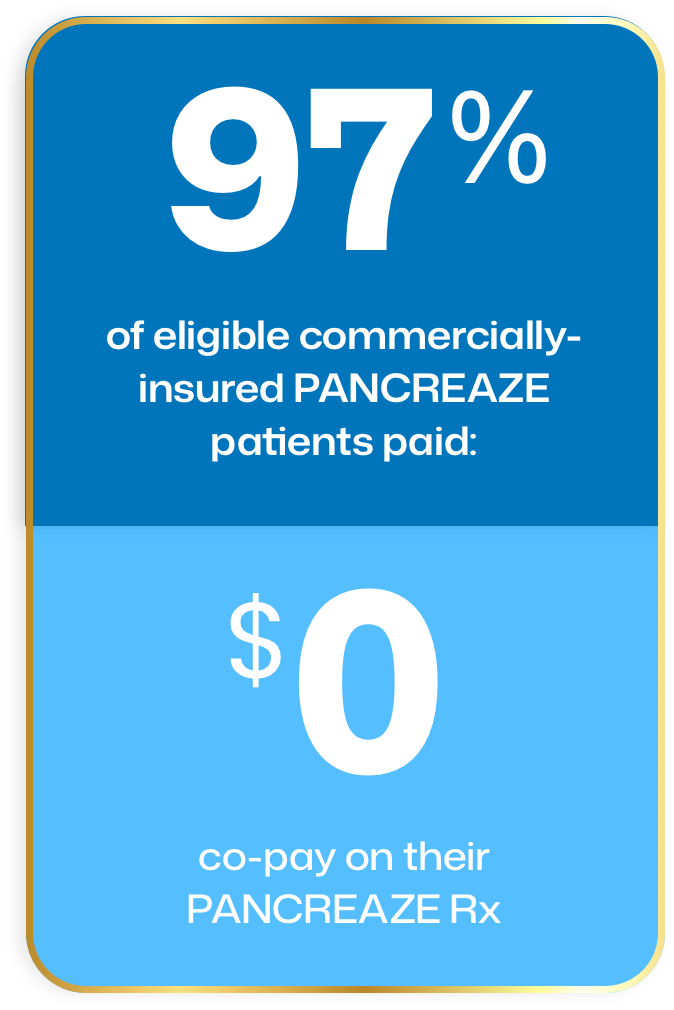
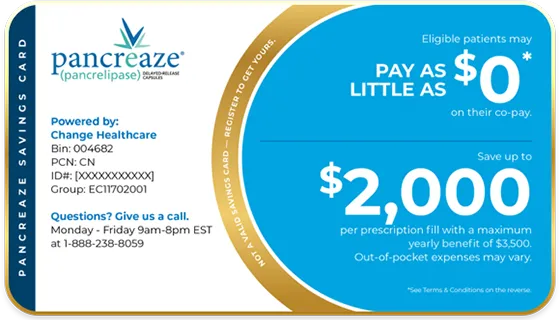
*Eligible patients may pay a minimum of $0 and receive up to $2,000 off the patient’s co-pay or out-of-pocket expenses per prescription fill of PANCREAZE (pancrelipase) capsules with a maximum yearly benefit of $3,500. Out-of-pocket expenses may vary. Click here for more information.
PANCREAZE is indicated for the treatment of exocrine pancreatic insufficiency in adult and pediatric patients.
Fibrosing Colonopathy: Associated with high doses, usually over prolonged use and in pediatric patients with cystic fibrosis. Colonic stricture reported in pediatric patients less than 12 years of age with dosages exceeding 6,000 lipase units/kg/meal. Monitor during treatment for progression of preexisting disease. Do not exceed the recommended dosage, unless clinically indicated.
Hyperuricemia has been reported with high dosages; consider monitoring blood uric acid levels in patients with gout, renal impairment, or hyperuricemia.
Irritation of the oral mucosa may occur due to loss of protective enteric coating on the capsule contents.
The presence of porcine viruses that might infect humans cannot be definitely excluded.
Monitor patients with known reactions to proteins of porcine origin. If symptoms occur, initiate appropriate medical management; consider the risks and benefits of continued treatment.
The most common side effects of PANCREAZE include blurred vision, abdominal pain, flatulence, constipation, nausea, pruritus, asymptomatic elevations of liver enzymes, myalgia, muscle spasm, urticaria and rash.
Please read the PANCREAZE Medication Guide and PANCREAZE Product Information.
References:
1. PANCREAZE Full Prescribing Information. Campbell, CA: VIVUS LLC; 2024.
2. Cystic Fibrosis Foundation. (n.d.). Phthalates. Retrieved from https://www.cff.org/phthalates.
3. Fieker A, Philpott J, Armand M. Enzyme replacement therapy for pancreatic insufficiency: present and future. Clin Exp Gastroenterol. 2011;4:55-73.
4. Othman MO, Harb D, Barkin JA. Introduction and practical approach to exocrine pancreatic insufficiency for the practicing clinician. Int J Clin Pract. 2018;72:e13066.
5. Whitcomb, DC, Buchner, AM, Forsmark, CE. AGA Clinical Practice Update on the Epidemiology, Evaluation, and Management of Exocrine Pancreatic Insufficiency: Expert Review. Gastroenterology. 2023;165:1292–1301.
6. Fousekis FS, Theopistos VI, Katsanos KH, Christodoulou DK. Pancreatic Involvement in Inflammatory Bowel Disease: A Review. J Clin Med Res. 2018;10(10):743-751.
7. Dominguez-Muñoz JE, et al. European PEI Multidisciplinary Group. European guidelines for the diagnosis and treatment of pancreatic exocrine insufficiency: UEG, EPC, EDS, ESPEN, ESPGHAN, ESDO, and ESPCG evidence-based recommendations. United European Gastroenterol J. 2025 Feb;13(1):125-172.
8. Singh VK, Haupt ME, Geller DE, Hall JA, Quintana Diez PM. Less common etiologies of exocrine pancreatic insufficiency. World J Gastroenterol. 2017 Oct 21;23(39):7059-7076.
9. Radlinger B, Ramoser, G and Kaser S. Exocrine Pancreatic Insufficiency in Type 1 and Type 2 Diabetes. Current Diabetes Reports. 2020;20:18.
10. Martin TCS, Scourfield A, Rockwood N, et al. Pancreatic insufficiency in patients with HIV infection: role of didanosine questioned. HIV Medicine (2013),14,161-166.
11. Price DA, Schmid ML, Ong ELC, et al. Pancreatic exocrine insufficiency in HIV-positive patients. HIV Medicine (2005),6,33–36.
12. Vujasinovic M, Valente R, Thorell A, et al. Pancreatic Exocrine Insufficiency after Bariatric Surgery. Nutrients. 2017 Nov 13;9(11):1241.
13. Uribarri-Gonzalez L, Nieto-García L, Martis-Sueiro A, et al. Exocrine pancreatic function and dynamic of digestion after restrictive and malabsorptive bariatric surgery: a prospective, cross-sectional, and comparative study. Surg Obes Relat Dis. 2021 Oct;17(10):1766-1772.
14. Struyvenberg MR, Martin CR, Freedman SD. Practical guide to exocrine pancreatic insufficiency – Breaking the myths. BMC Med. 2017; 15(1): 29.
15. Trapnell BC, Strausbaugh SD, Woo MS, et al. Efficacy and safety of PANCREAZE for treatment of exocrine pancreatic insufficiency due to cystic fibrosis. J Cyst Fibros. 2011;10(5):350-356.
16. The National Pancreas Foundation (n.d.). Exocrine Pancreatic Insufficiency (EPI). Retrieved from https://pancreasfoundation.org/patient-information/ailments-pancreas/exocrine-pancreatic-insufficiency-epi/
17. CREON® Full Prescribing Information. Chicago, IL: AbbVie, Inc; 2024.
18. PERTZYE® Full Prescribing Information. Bethlehem, PA: Digestive Care, Inc; 2024.
19. VIOKACE™ Full Prescribing Information. Bridgewater, NJ: Aimmune Therapeutics, Inc; 2024.
20. ZENPEP® Full Prescribing Information. Bridgewater, NJ: Aimmune Therapeutics, Inc; 2025.
21. Brennan GT, Saif MW. Pancreatic Enzyme Replacement Therapy: A Concise Review. JOP. 2019;20(5):121-125.
22. Barkin JA, Harb D, Kort J, Barkin J. Real-World Patient Experience With Pancreatic Enzyme Replacement Therapy in the Treatment of Exocrine Pancreatic Insufficiency. Pancreas. 2024 Jan 1;53(1).
23. Johns Hopkins Cystic Fibrosis Center. (n.d.). Effects of CF. Retrieved from https://hopkinscf.org/knowledge/effects-of-cf/
24. Cystic Fibrosis Foundation. Cystic Fibrosis Foundation evidence-based guidelines for management of infants with cystic fibrosis. J Pediatr. 2009 Dec;155(6 Suppl):S73-93.